Know parasites. Protect better.
Better protection begins with better awareness. This guide helps pet parents understand the risks, recognise common warning signs and work with their veterinarian to build an appropriate year-round parasite-control routine.
Tiny parasites. Significant impact.
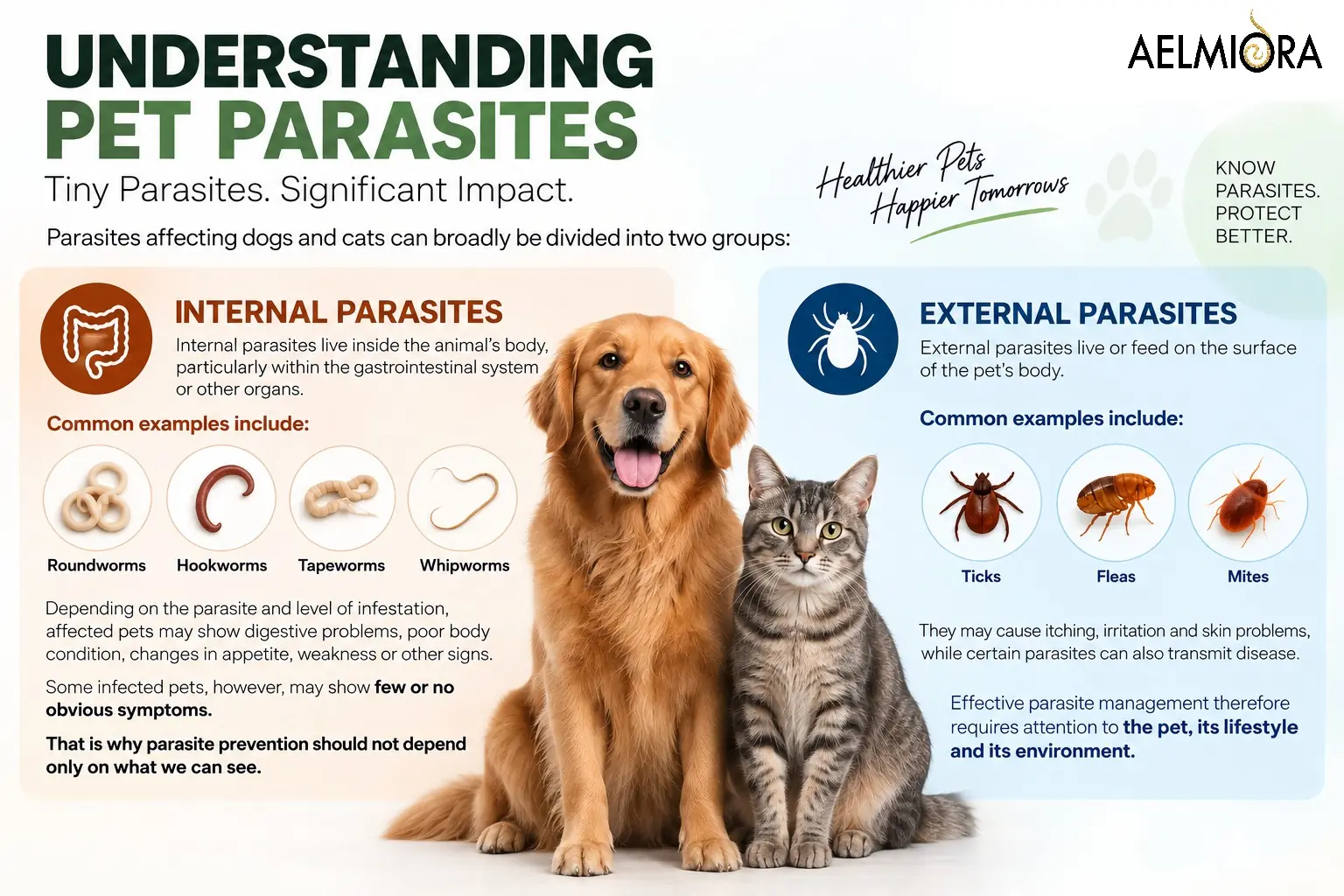
Parasites affecting dogs and cats can broadly be divided into two groups.
Internal parasites
Internal parasites live inside the animal’s body, particularly within the gastrointestinal system or other organs. Common examples include roundworms, hookworms, tapeworms and whipworms.
Depending on the parasite and level of infestation, affected pets may show digestive problems, poor body condition, changes in appetite, weakness or other signs. Some infected pets, however, may show few or no obvious symptoms. That is why parasite prevention should not depend only on what we can see.
External parasites
External parasites live or feed on the surface of the pet’s body. Common examples include ticks, fleas and mites. They may cause itching, irritation and skin problems, while certain parasites can also transmit disease.
Effective parasite management therefore requires attention to the pet, its lifestyle and its environment.
 (opens a zoomable viewer)
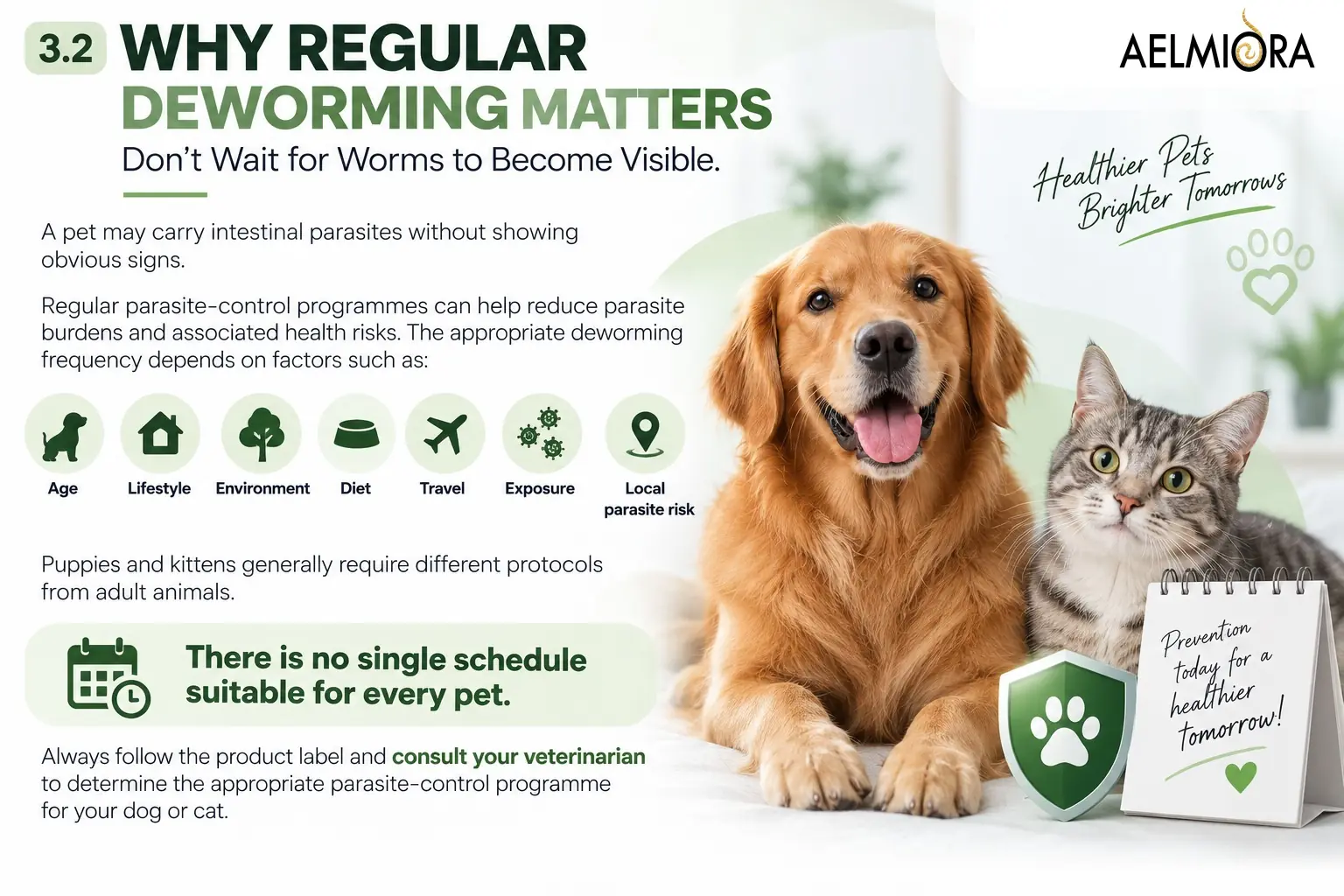
Don’t wait for worms to become visible.
A pet may carry intestinal parasites without showing obvious signs. Regular parasite-control programmes can help reduce parasite burdens and associated health risks.
The appropriate deworming frequency depends on factors such as age, lifestyle, environment, diet, travel, exposure and local parasite risk. Puppies and kittens generally require different protocols from adult animals.
There is no single schedule suitable for every pet.
Always follow the product label and consult your veterinarian to determine the appropriate parasite-control programme for your dog or cat.
 (opens a zoomable viewer)
Know the signs. Protect sooner.
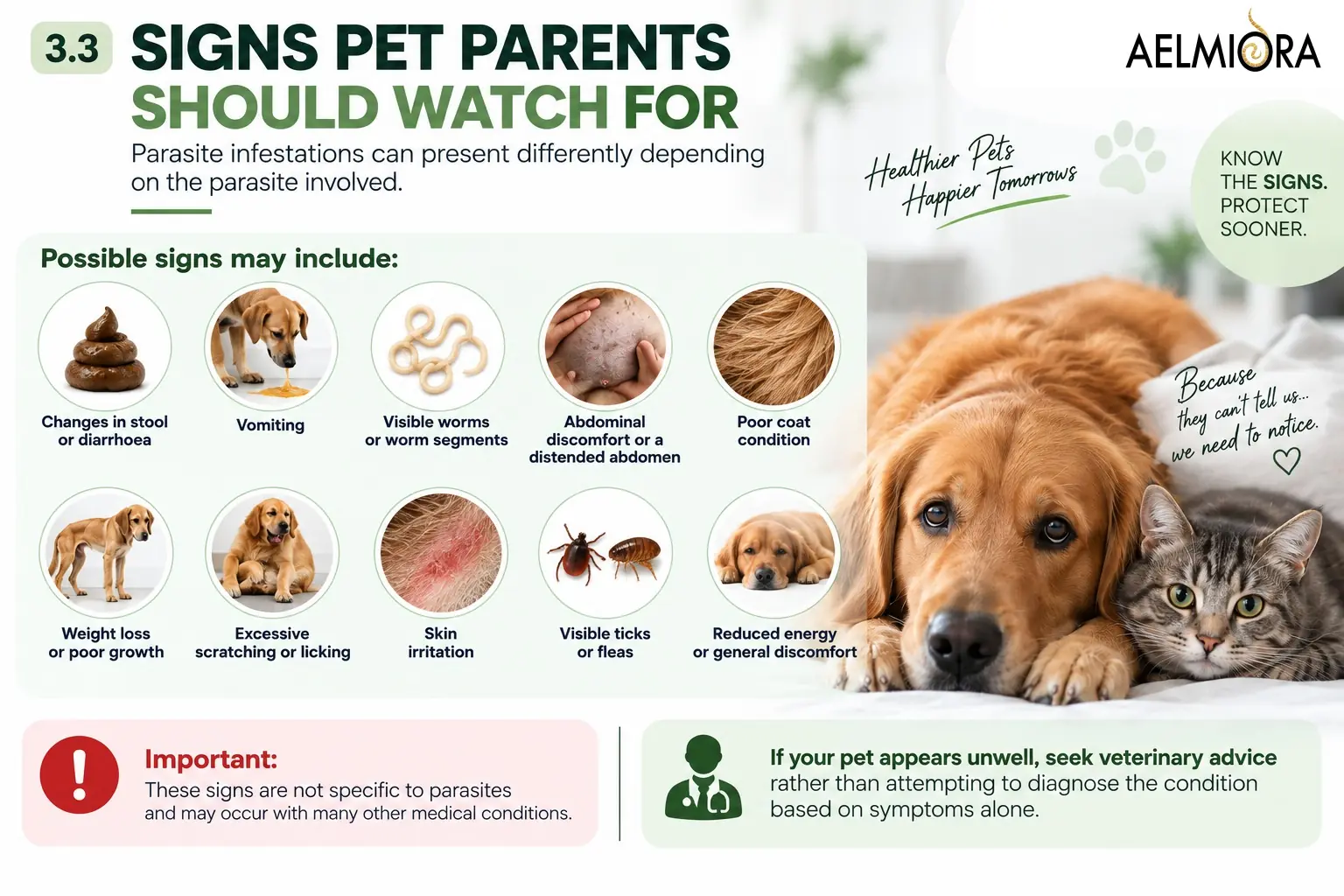
Parasite infestations can present differently depending on the parasite involved. Possible signs may include:
- Changes in stool or diarrhoea
- Vomiting
- Visible worms or worm segments
- Abdominal discomfort or a distended abdomen
- Poor coat condition
- Weight loss or poor growth
- Excessive scratching or licking
- Skin irritation
- Visible ticks or fleas
- Reduced energy or general discomfort
Important: These signs are not specific to parasites and may occur with many other medical conditions. If your pet appears unwell, seek veterinary advice rather than attempting to diagnose the condition based on symptoms alone.
 (opens a zoomable viewer)
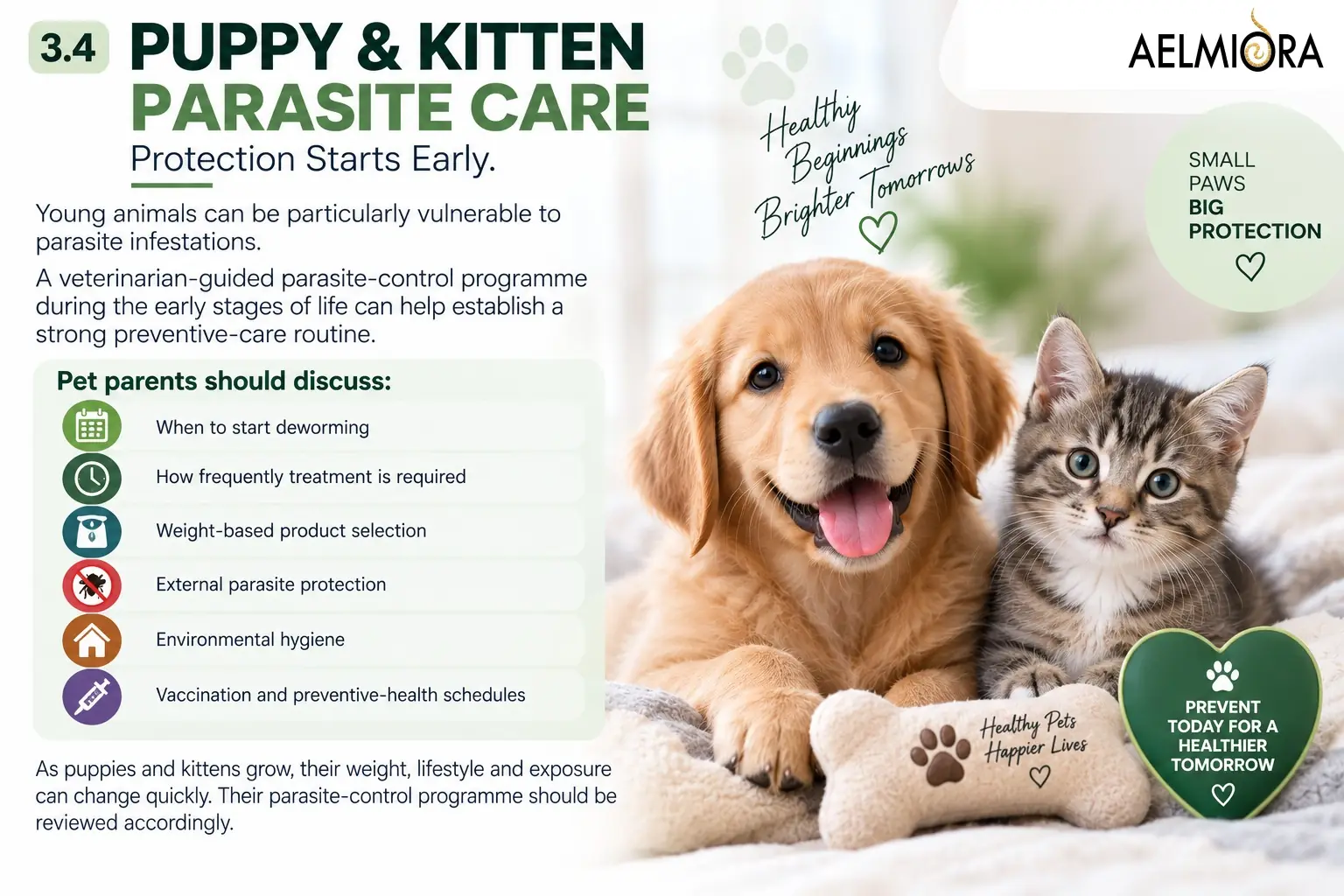
Protection starts early.
Young animals can be particularly vulnerable to parasite infestations. A veterinarian-guided parasite-control programme during the early stages of life can help establish a strong preventive-care routine.
Pet parents should discuss:
- When to start deworming
- How frequently treatment is required
- Weight-based product selection
- External parasite protection
- Environmental hygiene
- Vaccination and preventive-health schedules
As puppies and kittens grow, their weight, lifestyle and exposure can change quickly. Their parasite-control programme should be reviewed accordingly.
 (opens a zoomable viewer)
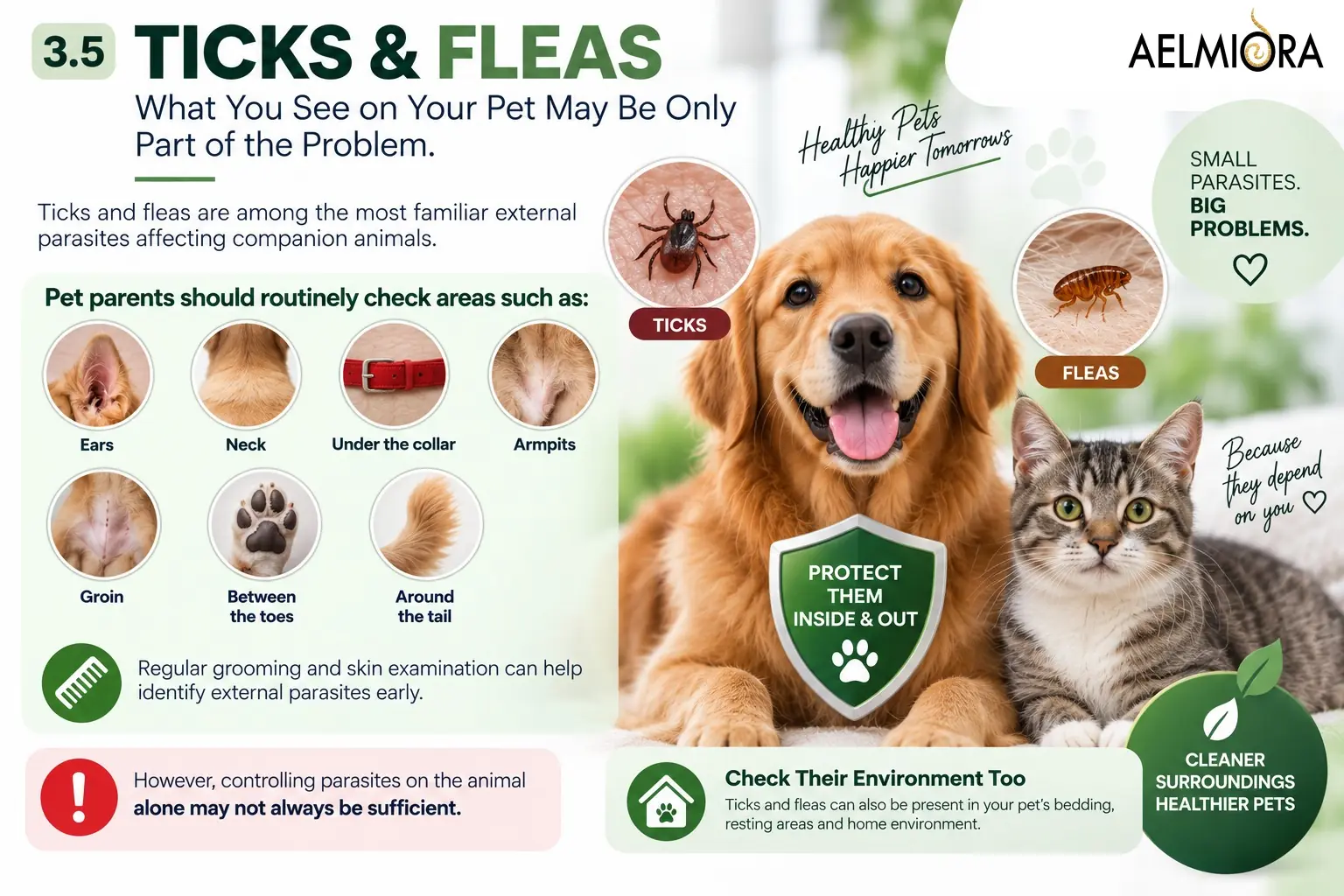
What you see on your pet may be only part of the problem.
Ticks and fleas are among the most familiar external parasites affecting companion animals.
Pet parents should routinely check areas such as the ears, neck, under the collar, armpits, groin, between the toes and around the tail.
Regular grooming and skin examination can help identify external parasites early. However, controlling parasites on the animal alone may not always be sufficient.
 (opens a zoomable viewer)
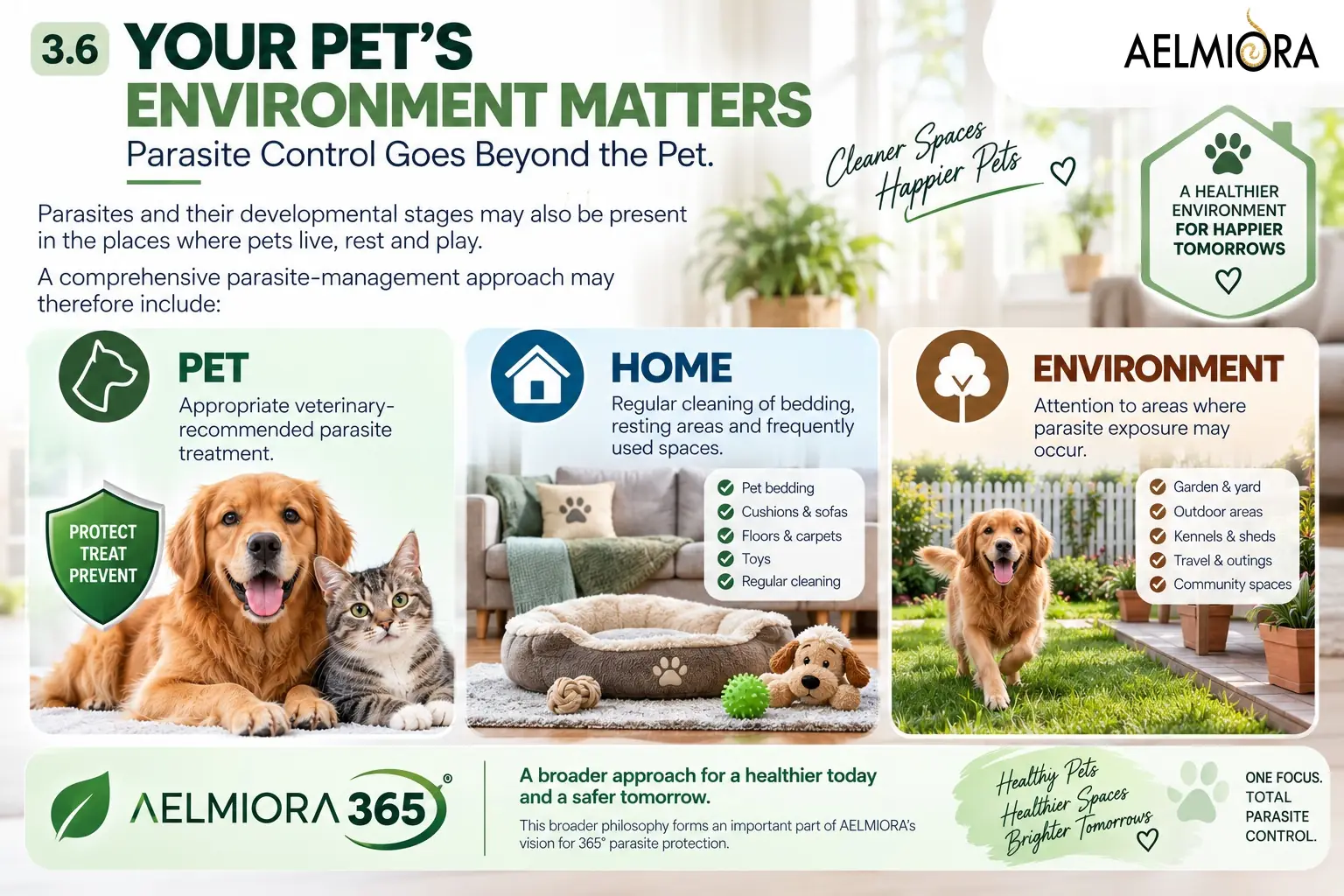
Parasite control goes beyond the pet.
Parasites and their developmental stages may also be present in the places where pets live, rest and play. A comprehensive parasite-management approach may therefore include:
- Pet
- Appropriate veterinary-recommended parasite treatment.
- Home
- Regular cleaning of bedding, resting areas and frequently used spaces.
- Environment
- Attention to areas where parasite exposure may occur.
This broader philosophy forms an important part of AELMIORA’s vision for 365° parasite protection.
 (opens a zoomable viewer)
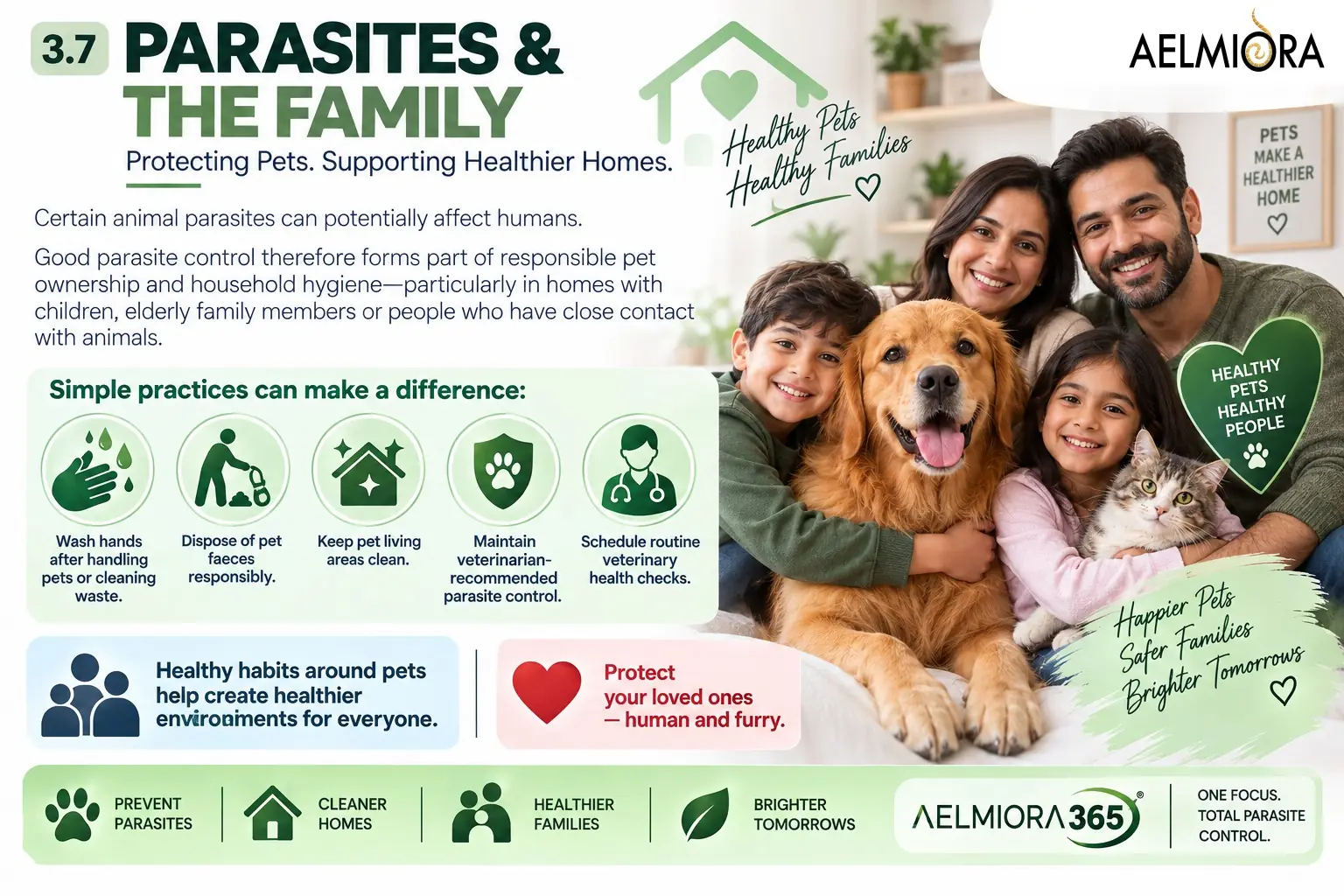
Protecting pets. Supporting healthier homes.
Certain animal parasites can potentially affect humans. Good parasite control therefore forms part of responsible pet ownership and household hygiene—particularly in homes with children, elderly family members or people who have close contact with animals.
Simple practices can make a difference:
- Wash hands after handling pets or cleaning waste.
- Dispose of pet faeces responsibly.
- Keep pet living areas clean.
- Maintain veterinarian-recommended parasite control.
- Schedule routine veterinary health checks.
Healthy habits around pets help create healthier environments for everyone.
 (opens a zoomable viewer)
In-depth guides
Select a topic to expand it.
Worms in dogs
Understand common intestinal worms, potential signs, transmission and prevention.
Worms in dogs
Understand common intestinal worms, potential signs, transmission and prevention.
Intestinal worms are common parasites that can affect dogs of all ages. Puppies, outdoor dogs and dogs frequently exposed to contaminated environments may face a higher risk of infection. Some intestinal parasites can also pose a potential health risk to people, making responsible parasite control important for the whole household.
Common intestinal worms in dogs
- Roundworms
- Commonly found in puppies and adult dogs. Infection may occur through contaminated soil, ingestion of infected animals or, for some species, transmission from the mother to puppies.
- Hookworms
- Small intestinal parasites that attach to the intestinal lining and feed on blood. Heavy infections can contribute to blood loss and anaemia, particularly in young puppies.
- Tapeworms
- Flat, segmented worms that may be transmitted when a dog swallows an infected flea or consumes certain infected intermediate hosts.
- Whipworms
- Parasites that live primarily in the large intestine. Dogs may become infected after ingesting infective eggs from contaminated soil or environments.
Potential signs of worms
Some dogs with intestinal worms may show few or no obvious signs. When signs occur, they can include:
- Diarrhoea or changes in stool
- Vomiting
- Weight loss or poor weight gain
- Reduced appetite
- Bloated or pot-bellied appearance
- Dull coat or reduced general condition
- Scooting or irritation around the rear
- Visible worms or worm segments in stool
- Weakness or pale gums in severe cases
These signs are not specific to worm infections and may occur with other medical conditions. Veterinary evaluation is therefore important.
How can dogs get worms?
Dogs may encounter intestinal parasites through contaminated soil, faeces, infected fleas, prey animals or other contaminated environments. Puppies may also acquire certain worms from their mother. Because parasite eggs and larvae may remain in the environment, reinfection can occur even after successful treatment.
Help reduce the risk
- Veterinary-guided deworming based on your dog’s individual risk and appropriate product recommendations.
- Regular faecal examinations when recommended by your veterinarian.
- Prompt removal of dog faeces from gardens, kennels and public areas.
- Effective flea control, which can help interrupt the transmission of certain tapeworms.
- Good environmental hygiene including regular cleaning of your dog’s living and sleeping areas.
- Routine veterinary check-ups to help determine an appropriate parasite-control plan.
Protection is more than a single treatment
Parasite exposure can occur throughout a dog’s life. Effective control therefore involves more than responding when worms become visible.
Treatment. Monitoring. Environmental Management. Veterinary Guidance.
Worms in cats
Learn about common feline intestinal parasites and responsible parasite management.
Worms in cats
Learn about common feline intestinal parasites and responsible parasite management.
Intestinal worms are common parasites that can affect cats at different stages of life. Kittens, outdoor cats, hunting cats and cats exposed to fleas or contaminated environments may face an increased risk of infection.
Some feline intestinal parasites can also have implications for human health, making appropriate parasite management important for both cats and the households they live in.
Common intestinal worms in cats
- Roundworms
- Among the most common intestinal parasites in cats. Cats may become infected by ingesting infective eggs from the environment or by eating infected prey. Kittens may also acquire certain roundworms through their mother’s milk.
- Hookworms
- Small parasites that attach to the intestinal lining and feed on blood. Depending on the species and severity of infection, hookworms may contribute to intestinal irritation, blood loss and anaemia.
- Tapeworms
- Flat, segmented intestinal worms. One common route of infection occurs when a cat swallows an infected flea while grooming. Cats that hunt and consume infected prey may also be exposed to certain tapeworm species.
Potential signs of worms
Some infected cats may show few or no obvious signs. When signs are present, they may include:
- Diarrhoea or changes in stool
- Vomiting
- Weight loss or poor growth
- Reduced appetite
- Bloated or pot-bellied appearance, particularly in kittens
- Dull or poor-quality coat
- Visible worms or worm segments in stool or around the rear
- Weakness or pale gums in more severe cases
These signs are not specific to intestinal parasites and may occur with other health conditions. Veterinary assessment is important for an appropriate diagnosis.
How can cats get worms?
Cats may encounter intestinal parasites through contaminated soil, faeces, infected fleas, hunting and eating infected prey, or exposure to contaminated environments. Even indoor cats are not necessarily free from parasite risk. Fleas and contaminated materials can occasionally enter the home, and individual risk varies according to lifestyle and environment.
Help reduce the risk
- Veterinary-guided deworming appropriate for your cat’s age, weight, lifestyle and individual parasite risk.
- Regular faecal examinations when recommended by your veterinarian.
- Effective flea control to help reduce exposure to flea-transmitted tapeworms.
- Regular litter-tray hygiene with prompt and safe disposal of faeces.
- Limiting hunting and prey consumption where practical.
- Maintaining a clean environment including bedding, feeding areas and frequently used spaces.
- Routine veterinary check-ups to help establish an appropriate parasite-control programme.
Indoor cats need attention too
Living indoors can reduce exposure to some parasites, but it does not necessarily eliminate the risk completely. A cat’s parasite-management plan should be based on its age, lifestyle, environment, flea exposure, hunting behaviour and veterinary assessment rather than simply whether it lives indoors or outdoors.
Treatment. Monitoring. Environmental Management. Veterinary Guidance.
Puppy deworming guide
Understand why parasite management begins early and what to discuss with your veterinarian.
Puppy deworming guide
Understand why parasite management begins early and what to discuss with your veterinarian.
Puppies can be exposed to intestinal parasites from a very young age. Certain worms may be transmitted from the mother before birth or through nursing, while others may be acquired from contaminated environments as puppies begin exploring their surroundings.
Because puppies are still growing and developing, significant parasite burdens can have a greater impact on their health than they might in healthy adult dogs.
Why does deworming begin early?
Some intestinal worms, particularly roundworms and hookworms, can affect puppies during the earliest stages of life. Depending on the type and severity of infection, intestinal parasites may interfere with normal growth, nutrition and gastrointestinal health. Heavy infections can potentially lead to more serious complications. This is why parasite management should form part of a puppy’s routine veterinary care from an early age.
How do puppies get worms?
- Transmission from the mother
- Nursing
- Contaminated soil or environments
- Contact with infected faeces
- Ingestion of infected fleas or prey
- Grooming or licking contaminated surfaces
Because parasite eggs and larvae may persist in the environment, exposure and reinfection can occur even after treatment.
Potential signs to watch for
- Bloated or pot-bellied appearance
- Diarrhoea or abnormal stools
- Vomiting
- Poor growth or difficulty gaining weight
- Reduced appetite
- Dull coat
- Visible worms or worm segments in stool
- Weakness or reduced activity
- Pale gums, particularly with significant blood loss
These signs can also occur with many other puppy health conditions. A veterinarian should evaluate puppies showing illness rather than assuming worms are the cause.
When should puppy deworming start?
There is no single parasite-control programme suitable for every puppy. The appropriate timing, frequency and choice of treatment depend on factors such as age, body weight, health status, parasite risk, environment, lifestyle and previous treatment. Your veterinarian can recommend an appropriate programme based on your puppy’s individual needs and the approved directions for the selected veterinary medicinal product.
Never give a puppy a deworming medicine simply because it was previously prescribed for another dog.
What should you discuss with your veterinarian?
- When parasite treatment should begin
- How frequently your puppy should be assessed or treated
- Which intestinal parasites are relevant in your area
- Whether a faecal examination is recommended
- The correct product and dose for your puppy’s current weight
- Flea and tick management
- Vaccination and preventive healthcare
- Environmental hygiene and prevention of reinfection
Hygiene matters too
Medication alone does not address every source of parasite exposure. Promptly remove faeces, regularly clean bedding and living areas, maintain appropriate flea control and prevent puppies from eating faeces, prey or other potentially contaminated material. Good hand hygiene is also important.
Start early. Stay consistent.
Kitten deworming guide
A simple introduction to parasite protection during the early stages of a kitten’s life.
Kitten deworming guide
A simple introduction to parasite protection during the early stages of a kitten’s life.
Kittens can be exposed to intestinal parasites from a very young age. Certain worms may be passed from the mother during nursing, while others can be acquired through contaminated environments, fleas or infected prey. Because kittens are growing rapidly, significant parasite infections can affect their nutrition, growth and overall wellbeing.
How do kittens get worms?
- Transmission through their mother’s milk
- Contaminated soil or environments
- Contact with infected faeces
- Ingestion of infected fleas
- Hunting or eating infected prey
- Grooming contaminated fur or surfaces
Even kittens kept primarily indoors may still have some exposure risk, particularly through fleas or contaminated materials entering the home.
Potential signs to watch for
- Bloated or pot-bellied appearance
- Diarrhoea or changes in stool
- Vomiting
- Poor growth or difficulty gaining weight
- Reduced appetite
- Dull or poor-quality coat
- Visible worms or worm segments in stool
- Weakness or reduced activity
- Pale gums in more severe cases
These signs are not specific to intestinal worms and can occur with other health conditions. Veterinary examination is important when a kitten appears unwell.
What should you discuss with your veterinarian?
- When parasite treatment should begin
- How frequently parasite control may be required
- Which intestinal parasites are relevant in your area
- Whether a faecal examination is appropriate
- The correct product and dose for your kitten’s current weight and age
- Flea and tick management
- Vaccination and routine preventive healthcare
- Indoor versus outdoor lifestyle risks
Flea control matters
Fleas can play a role in transmitting certain tapeworms. A kitten that swallows an infected flea while grooming may become infected with tapeworm, so intestinal parasite management and flea control should be considered together.
Keep the environment clean
Regularly clean litter trays, safely dispose of faeces, wash bedding and maintain good household hygiene. Always wash your hands after cleaning litter trays or handling animal waste.
Start early. Protect as they grow.
Ticks & fleas
Learn how external parasites affect pets and why environmental control matters.
Ticks & fleas
Learn how external parasites affect pets and why environmental control matters.
Ticks and fleas are common external parasites that can affect dogs and cats. Infestations may cause skin irritation, discomfort and, depending on the parasite and geographic region, contribute to the transmission of certain diseases.
Protect the pet. Manage the environment. Reduce reinfestation.
What are ticks?
Ticks are external parasites that attach to an animal’s skin and feed on blood. Pets may encounter ticks in grass, vegetation, gardens and outdoor areas. Depending on the tick species and location, ticks may also transmit certain infectious organisms.
What are fleas?
Fleas are small, fast-moving insects that feed on blood. Adult fleas live and feed on animals, but much of the flea life cycle can occur away from the pet. Eggs may fall into bedding, carpets, furniture, cracks and other areas where pets spend time.
Potential signs of ticks & fleas
- Frequent scratching or biting at the skin
- Excessive licking or grooming
- Red or irritated skin
- Hair loss
- Scabs or skin lesions
- Visible ticks attached to the skin
- Fleas moving through the coat
- Flea dirt—small dark specks within the coat
- Restlessness or discomfort
- Pale gums or weakness in severe infestations
Why can fleas keep coming back?
Flea eggs, larvae and pupae can be present in the surrounding environment and may eventually produce new adult fleas that return to the pet: Pet → Environment → Development → Pet. Breaking this cycle may require treatment of the animal together with environmental management.
Environmental control may include
- Regularly washing pet bedding
- Vacuuming carpets, furniture and areas where pets rest
- Cleaning kennels, crates and sleeping areas
- Maintaining gardens and outdoor areas
- Treating all relevant pets in the household when advised
- Using appropriate environmental parasite-control measures where necessary
Ticks can be easy to miss
Ticks may attach around the ears, neck, face, between the toes, under the collar, around the legs and other less-visible areas. If you are uncertain about safely removing a tick, or notice redness or swelling around the attachment site, consult your veterinarian.
How often should I deworm my pet?
Understand the factors veterinarians consider when developing an appropriate deworming schedule.
How often should I deworm my pet?
Understand the factors veterinarians consider when developing an appropriate deworming schedule.
The answer is not necessarily the same for every dog or cat. An appropriate deworming programme depends on your pet’s age, species, lifestyle, environment, geographic location and potential exposure to parasites. Speak with your veterinarian about a plan appropriate for your individual pet.
Right pet. Right approach. Right veterinary guidance.
Factors veterinarians may consider
Age, species, body weight, health status, lifestyle, environment, geographic location, flea exposure, hunting behaviour and contact with other animals.
Lifestyle questions your vet may ask
- Does your pet spend significant time outdoors?
- Does your dog regularly visit parks or shared exercise areas?
- Does your cat hunt rodents, birds or other prey?
- Does your pet live with other animals?
- Does your pet attend boarding, daycare or grooming facilities?
- Does your pet have a history of flea infestation?
- Does your pet eat raw meat or potentially infected prey?
- Does your pet travel to different geographic areas?
Should stool testing be part of the plan?
Faecal examinations can help identify evidence of certain intestinal parasites. However, a negative test does not necessarily exclude every parasite infection at every stage. Your veterinarian can advise whether testing is appropriate.
Don’t simply repeat an old dose
Pets grow, gain or lose weight and experience changes in health and lifestyle. Always check your pet’s current body weight, follow veterinary guidance and use veterinary medicinal products according to their approved label. Never use a product intended for one animal species in another unless specifically directed by a veterinarian and permitted by the product instructions.
Every pet is different. Parasite protection should reflect that.
Parasites & people
Learn why responsible parasite control is important for pets, families and shared environments.
Parasites & people
Learn why responsible parasite control is important for pets, families and shared environments.
Certain parasites are zoonotic, meaning they have the potential to pass between animals and people under particular circumstances. Responsible parasite management therefore protects more than an individual pet.
Healthy pets. Healthier homes. Shared responsibility.
Which pet parasites can affect people?
- Roundworms
- Certain roundworms of dogs and cats can contaminate the environment with microscopic eggs passed in faeces. People may be exposed if infective eggs are accidentally ingested from contaminated soil, hands or surfaces.
- Hookworms
- Some hookworm larvae can be present in contaminated soil or sand and may penetrate human skin following direct contact.
- Tapeworms
- Some tapeworm species associated with pets can have zoonotic importance. Transmission routes vary and may involve fleas or other intermediate hosts.
- Ticks
- Ticks can carry infectious organisms capable of affecting animals and people. Risk varies considerably by tick species and region.
- Fleas
- Fleas can bite people as well as pets and may participate in the transmission cycles of certain infectious organisms and parasites.
Children may require particular attention
- Encourage regular handwashing
- Supervise interaction between young children and pets
- Prevent children from playing in areas contaminated with animal faeces
- Keep sandpits covered when not in use
- Remove pet faeces promptly
- Maintain appropriate parasite control for household pets
One Health: pets, people & the environment
Animal health, human health and environmental health are interconnected. Responsible parasite management reflects this by considering not only treatment of an individual animal, but also transmission, household hygiene and environmental contamination.
Protecting pets helps protect the world they share with us.
Parasite myths & facts
Separate common misconceptions from responsible parasite-care practices.
Parasite myths & facts
Separate common misconceptions from responsible parasite-care practices.
Know the facts. Understand the risk. Protect responsibly.
Myth 01“My pet looks healthy, so it can’t have worms.”
Fact: Not every parasite infection produces obvious signs. Some dogs and cats may carry intestinal parasites while appearing completely healthy.
Myth 02“Indoor pets don’t get parasites.”
Fact: Living indoors may reduce exposure, but it does not necessarily eliminate the risk. Fleas, parasite eggs and contaminated material may sometimes enter the home.
Myth 03“I only need to deworm my pet when I see worms.”
Fact: Many intestinal parasites—or their eggs—may not be easily visible. Waiting until worms are visible may mean an infection has been present for some time.
Myth 04“One deworming treatment protects my pet forever.”
Fact: Deworming does not necessarily prevent future exposure or reinfection. Parasite management is an ongoing process rather than a one-time event.
Myth 05“All dewormers are the same.”
Fact: Different products may contain different active ingredients and target different parasites. Always follow veterinary guidance and the approved product label.
Myth 06“The same dose works for every pet.”
Fact: Many veterinary medicinal products are dosed according to species, body weight and age. Correct pet. Correct product. Correct dose.
Myth 07“If I treat my pet for fleas, the problem is solved.”
Fact: Flea eggs, larvae and pupae can be present in bedding, carpets and furniture. Successful management may require attention to the pet, other pets and the environment.
Myth 08“Ticks are only a problem in summer.”
Fact: Tick activity depends on climate, geography, environmental conditions and species. Discuss your pet’s actual exposure risk with your veterinarian.
Myth 09“My cat never goes outside, so it doesn’t need parasite care.”
Fact: Indoor cats may have a different parasite risk, but the risk is not automatically zero. Fleas can enter homes.
Myth 10“Parasite control is only about my pet.”
Fact: Some parasites may also have implications for other animals, people and the environment—the One Health relationship.
Myth 11“More frequent treatment must mean better protection.”
Fact: The appropriate product and interval should reflect the pet’s individual risk and the approved directions. More is not automatically better. Appropriate is better.
Myth 12“Parasite prevention is just a tablet.”
Fact: Responsible protection also includes monitoring, environmental management, external parasite control and veterinary guidance.
Don’t guess. Know the risk.
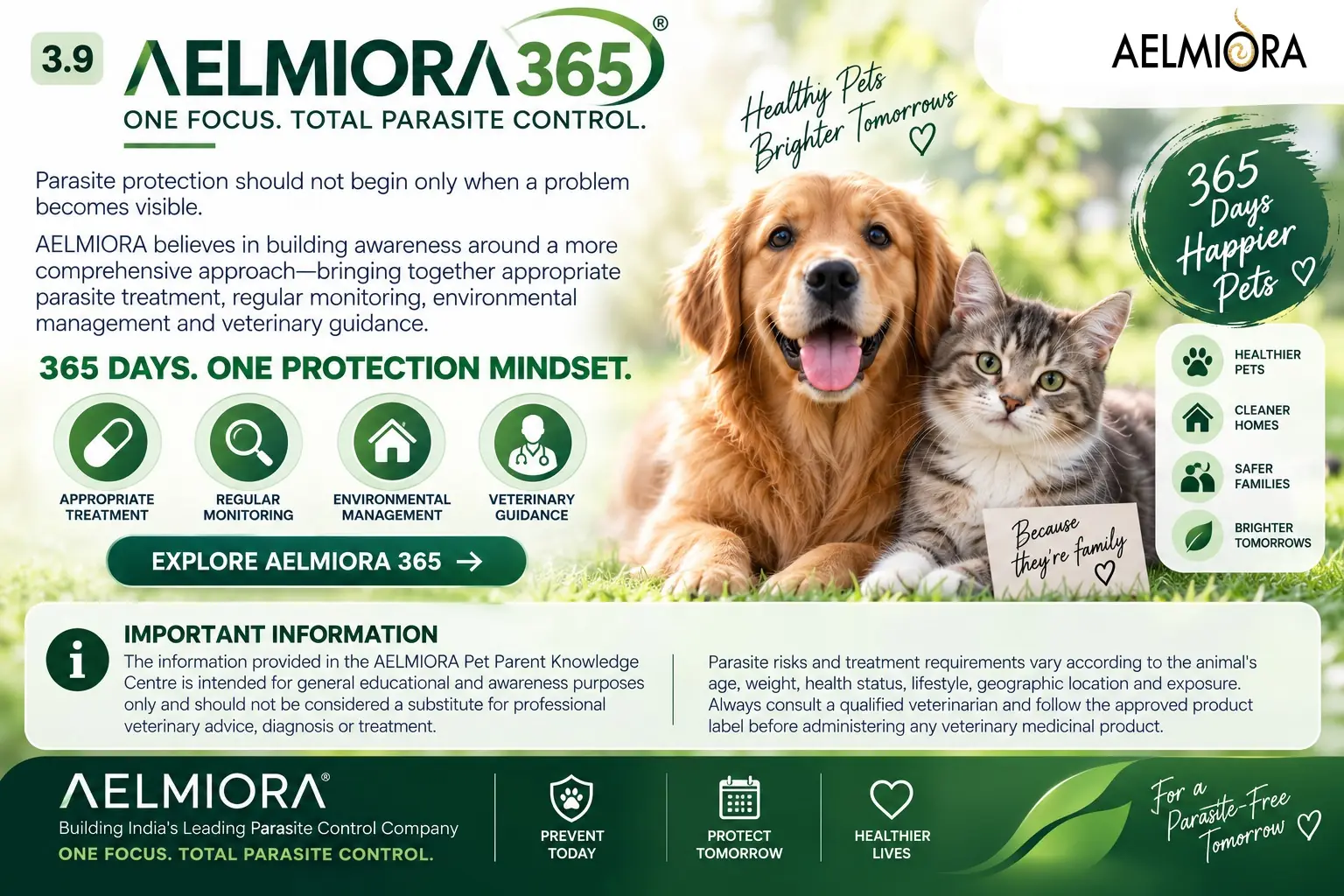
365 days. One protection mindset.
Parasite protection should not begin only when a problem becomes visible. AELMIORA believes in building awareness around a more comprehensive approach—bringing together appropriate parasite treatment, regular monitoring, environmental management and veterinary guidance.
 (opens a zoomable viewer)
Important information. This information is intended for general educational and awareness purposes only and should not be considered a substitute for professional veterinary advice, diagnosis or treatment. Parasite risks and treatment requirements vary according to the animal’s age, weight, health status, lifestyle, geographic location and exposure. Always consult a qualified veterinarian and follow the approved product label before administering any veterinary medicinal product.